Gains
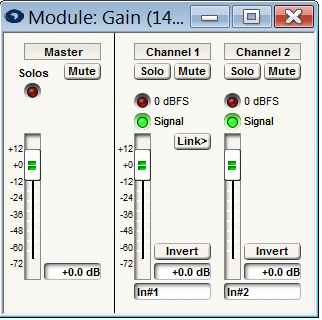 Each gain block in an N by N input/output block. For every input there is a corresponding output. Each input feeds it's corresponding output. There is no mixing capability, the channels pass directly to their corresponding output through the gain stage. If mixing is needed, please investigate using a Matrix Mixer. For gain modules containing more than (8) channels the module control uses multiple tabs to show the information for all channels.
Each input channel strip posses:
- Gain Fader.Increases, or decreases the gain through the channel fader. You can specify a precise gain value by clicking the text box at the lower right of the fader and entering the desired value in dB.
- Invert Button. Inverts the polarity of the channel audio signal. This is similar to the phase "φ" button found on many audio consoles.
- Mute Button. Mutes the channel.
- Solo Button. Solos the channel by muting any non soloed channel.
Note: The Solo function works by muting the non-soloed channels. This is considered "solo in place", or "destructive solo." Please don't confuse it with PFL, or AFL. There is not a separate Solo, or Control Room bus, so if a channel is put into Solo mode during operation, the sound system listeners will know it.
- Signal Present Indicator. Illuminates at -54dBFS
- 0 dBFS Indicator. This virtual LED does not indicate that clipping has occurred when illuminated, but indicates that clipping at the output will occur unless the signal is attenuated by a downstream module.
For all Gain Modules other than the Mono Module there is a master fader along with a mute button provided. The master fader applies gain to all channels equally. The gain (in dB) for each channel is the sum of the channel fader and the master fader gains. The master mute button mutes all outputs. The master fader can be used for ganging multiple signals and controlling them from a single fader. Use the individual channel faders to set the relative levels of the ganged signals and the master fader to control the overall level of all the signals. This feature is especially useful with Control Screens and for remote control.
High Gain Mono
The High Gain Mono module allows applying very large boosts or cuts in the signal level using either floating-point or 24-bit fixed point processing to compare the effects. A suggested use is to apply a maximum cut (say 120 dB) followed by a maximum boost and compare the results of floating and fixed-point implementation. The fixed point will typically sound grainy and distorted, whereas the floating-point will sound perfect.