Expander/Gates
An Expander, or Gate, reduces the gain of lower level signals without reducing the total dynamic range. Above a user defined threshold setting, signal levels remain unchanged. Below threshold, signals are reduced by some degree. Expanders and gates differ by the rate of change of the input/output curve when the signal is below the threshold level. An expander reduces the level gradually for decreasing input levels, whereas a gate drops the gain precipitously for a small decrease below threshold level. A glance at the input/output curves for these two devices makes the differences clear.
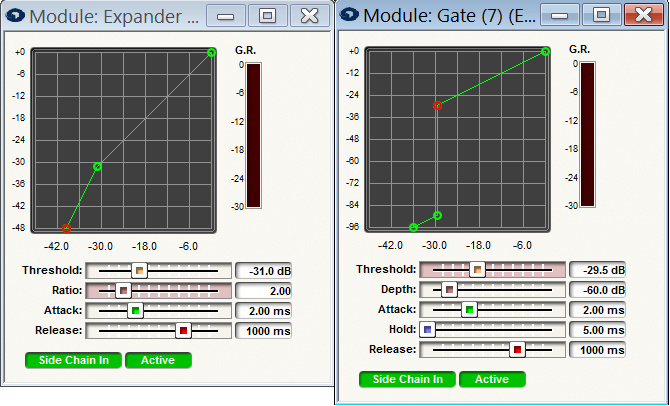
Sidechain. An expander gate has a signal input and a sidechain input labeled "Side". A stereo expander gate has two signal inputs and one sidechain input labeled "Side". The "Side" input is used to allow a signal other than the input to control the expander gate. Using this feature you can use one audio signal to turn on or off another audio signal. If nothing is connected to the "Side" input, then the input signal is effectively shorted to the "Side" input (standard operation). In other words, if nothing is connected to the "Side" Input, even if the "Side Chain In" button is engaged, it is the signal at the input that triggers the expander/gate.
Mono vs. Stereo. The controls for mono vs. stereo expander/gates are identical. The input and output meters for the stereo version show (2) channels vs. (1) channel shown in the mono version. For the stereo version, the gain reduction is directed by the loudest of the 2 inputs. Both outputs are affected identically.
Ctrl Output. The module has a control signal output. The control signal reflects the dynamic gain reduction being applied by the module and changes in real time. This control signal can be used to easily create linked multi-channel dynamics modules. See Creating Multi-channel Dynamics Modules for more information.
SymetrixExpandershave the following controls:
- Threshold. The level that the signal must exceed to open the expander (let it pass signal).
- Ratio. The slope of the gain curve below the threshold point. A high ratio setting begins to approximate the action of a gate.
- Attack. The duration of the input signal, over threshold, required to open the expander. Faster attack times let shorter transients open the expander.
- Release. The amount of time required for the gain to return to the below-threshold value after the input signal falls below threshold.
- Side Chain In. When pressed, the module uses the side chain input to control the gating, or expansion. When not pressed, the input signal is used to control the gating or expansion (standard operation). If nothing is connected to the Side input and the Side Chain In is pressed, the mdoule will be set for maximum signal attenuation.
- Active. Activates the module so that the gain reduction is inserted into the audio signal path.
- Meter. A gain reduction meter labeled "G.R." is provided so that the effect of the expander, or gate can be observed.
SymetrixGateshave the following controls.
- Threshold. The level that the signal must exceed to open the expander (let it pass signal).
- Depth. The gain change applied to the signal when it falls below the threshold and the gate closes. For example, a Depth setting of 40dB means that when the gate is closed, the output signal will be 40 dB lower.
- Attack. The duration of the input signal, over threshold, required to open the expander. Faster attack times let shorter transients open the gate.
- Hold. Once the input signal crosses the threshold level, the gate remains open for the Hold time even if the input signal has fallen below the threshold level.
- Release. The amount of time that the expander takes to lower the gain to that set by the Depth control after the input signal falls below the threshold and the Hold time has expired.
- Side Chain In. When pressed the module uses the side chain input to control the gating, or expansion. When not pressed, the input signal is used to control the gating or expansion (standard operation). If nothing is connected to the Side input and the Side Chain In is pressed, the module will be set for maximum signal attenuation.
- Active. Activates the module so that the gain reduction is inserted into the audio signal path.
- Meter. A gain reduction meter labeled "G.R." is provided so that the effect of the expander, or gate can be observed.