DeEssers
A DeEsser dynamically reduces the high-frequency content of a signal. They are typically used on speech signals to reduce sibilance, but may be used on other program material as well. The Symetrix DeEsser uses an adaptive algorithm to determine when to DeEss. When the high frequency content exceeds the low frequency content by a certain amount, it begins to cut the highs. This allows it to work with signals of widely varying levels and signifies that the module doesn't require a threshold control.
Mono vs. Stereo. The controls for mono vs. stereo limiters are identical. For the stereo version, the high frequency reduction is controlled by the input which has the most relative high frequency content. Bptj pit[its are affected identically. For best results, make sure both stereo inputs are at approximately the same level.
Ctrl Output. The DeEsser modules have a single control signal output the control signal reflects the high frequency dynamic gain reduction being applied by the module and changes in real time. It may be useful as a way of monitoring what the module is doing.
Look-ahead. In order to react to fast peaks more smoothly, this module uses a (24) sample, 0.5ms "Look-Ahead." In other words, the output of the module is delayed (24) samples from the input.
The Symetrix DeEsser has the following controls:
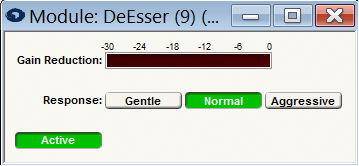
- Response radio button. These allow setting the response of the module to either gentle, normal, or aggresive. This parameter is best adjusted by ear.
- Active. Activates the module so that the high frequency attenuation produced by the module is inserted into the audio signal path.
- Gain Reduction Meter. The meter indicates the amount of high-frequency gain reduction that the DeEsser is currently applying.