Gain-sharing Echo Reducer
Introduction
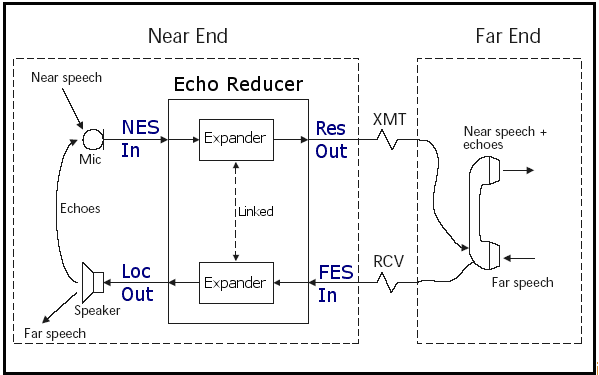
In remote conferencing applications, echo is a common problem. Consider the scenario of a remote talker on a standard telephone handset, conferencing into a large room with loudspeakers and microphones (see diagram below). As the remote, or far end talker speaks, the audio is sent out of the loudspeakers and is then picked up by the microphones, which send the audio back to the remote loudspeaker. The result is that the remote talker hears and echo of his or her own speech. This can be quite annoying, especially with longer round-trip delays, and makes effective communication difficult.
An echo reducer is used to provide better audio quality for the remote talker. There are two main strategies for reducing this echo:
1. Adaptive filtering
2. Dynamic gain modification (sometimes called non-linear processing).
Composer offers both adaptive filtering and dynamic gain modification in the form of a gain-sharing echo reducer. Gain-sharing devices can be quite effective for certain applications. These modules can help by reducing moderate amounts of echo and have the advantage of very low DSP processing requirements.
The table below summarizes some of the differences between an adaptive filter-based, and a Gain-sharing-based echo reducer.
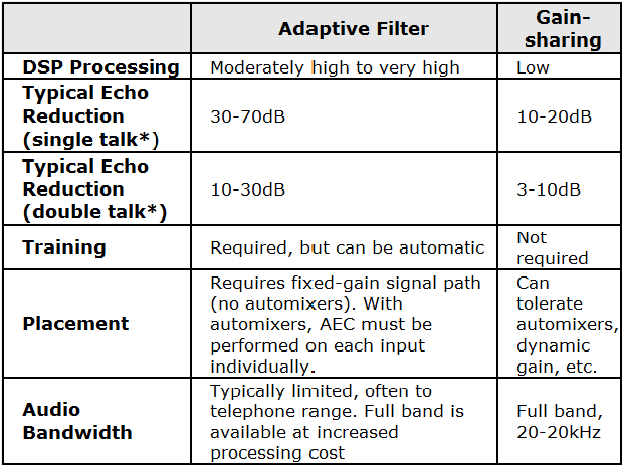
*See the glossary below for definitions of these and other terms.
Functionality
The Gain-sharing Echo Reducer dynamically shares gain between the near and far end signals. The end with the loudest signal receives the most gain. This reduces echo, since when the far end is speaking the near end microphone input signal is attenuated, preventing echo from being sent back to the far end. This is sometimes referred to as teeter-totter, or see-saw operation. You can think of the module as two expanders, which are linked together, each tracking what the other is doing. The expanders threshold is automatically and dynamically determined based on the incoming signal levels. Yeat another way of viewing the modules is as a two-channel automixer and in fact, the design was derived from the Symetrix automixer.
Set-up Notes
This gain-sharing module discriminates echo pickup from near end speech primarily based on signal levels. This means that for the module to be effective, the near end speech must me louder than the echo pick-up. This can be achieved through careful loudspeaker and microphone placement, use of directional microphones, acoustic damping, etc. Ideally, the microphones should be placed for maximum pickup of the near end talkers and minimum pickup of the loudspeakers. This normally means close to the near end talkers and far from the loudspeakers, though with directional microphones, angle is important as well. For best results, try to ensure that the near end talkers are at least 10dB louder than the loudspeaker pickup, as heard by the near end microphones. The great the difference between the near end talker level and the loudspeaker pickup level, the greater the echo reduction will be.
Also, for best operation, the levels of the near and far end signals should match as closely as possible when each side is speaking in a normal voice. If the levels do not match insert gain modules before the echo reducer. Slight mismatches may also be adjusted for using the Bias control.
If the near end uses multiple microphones, simply mix them together with an automixer, which is preferred, or a standard mixer and send the mix to the Near input.
Double-talk Considerations
Double-talk is the condition when both the far and near end are talking at the same time. This is the most difficult scenario for an echo canceller to deal with. When this condition occurs, the module typically reduces the volume of each side by a small to moderate amount. If one side is significantly louder than the other, the louder side with tend "win" and receive more gain. The Bias control also affects this behavior and can be used to help the near, or far side "win" the gain battle. Also, the Amount control affects how much reduction occurs during double-talk, with large values yielding more gain reduction.
Inputs and Outputs
-
Near Input. This is the connection for the Near End Speech signal. This is typically from a microphone in the local room. In an installation with multiple microphones, it would generally be the mix of all microphones, possibly coming from an automixer.
-
Far Input. This is the connection for the Far End Speech signal. This may be from a telephone hybrid, or the other tie-line to the remote location.
-
Far Output. This is the signal to send to the far end. It is a processed version of the Near input signal, ideally containing only the audio originating in the near end room and not he fare end pick-up.
-
Near Output. This is the signal to send to the local loudspeakers to hear the far end speech. It is a processed version of the Far input signal, ideally containing the Far signal only when that side is active and silence when it is incative.
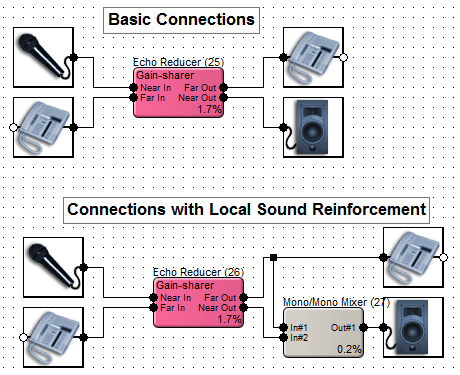
The diagrams below show the typical connections to the module. the top version is for smaller rooms where there is no need to amplify the local speech. The bottom version is intended for larger venues where local sound reinforcement is needed. In the second diagram the local talkers need to be amplified so they can be clearly heard by others in the same large room .In both cases, the far end is assumed ot be connected through a telephone interface.
Controls
The module has the following controls:
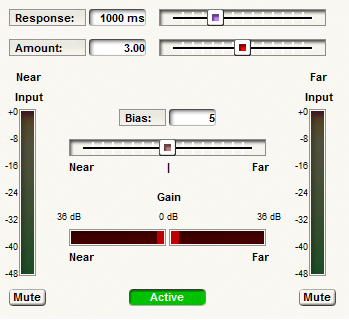
- Response. This field indicates the response time of the module in milliseconds. This parameter controls how quickly the module responds to changing levels in the near and far end signals. Very fast responses may cause pumping and breathing between words. Very slow responses may cause the beginnings of words to be clipped or attenuated. Settings in the 500-1000 millisecond range typically work well for most speech applications. If there is a very large delay between the two sides, theis time may need to be increased. Adjust using the slider or click in the text entry field to specify a numerical value.
- Amount. This controls how aggressive the operation of the module is. Larger amounts typically result in more echo attenuation, but may also have more artifacts. Smaller amounts have a more subtle effect, but less echo reduction. Adjust using the slider or click in the text entry field to specify a numerical value.
- Bias. This controls what the module does when both sides are talking at once. Moving toward the Near or Far causes that respective side to be given more weight and the other side to be attenuated more. If both sides are talking at the same level, the center position of 5 would cause both sides to be attenuated by an equal amount. Adjust using the slider, or click in the text entry field to specify a numerical value.
- Mute buttons. Pressing this button mutes either the Near or Far inputs.
- Bypass button. Pressing this button bypasses the module so that Far Out = Near In and Near Out = Far In.
- Near Input Meter. This meter shows the peak level of the Near input after it has gone through a voice-band filter.
- Far Input Meter. This meter shows the peak level of the Far input after it has gone through a voice-band filter.
- Gain Meter. This meter shows how the gain is being shared between the near and far sides.
Glossary of Terms
Single-talk - The case where only one party at a time is speaking. This scenario is representative of the majority of conversations and is the easiest case for an echo canceller to handle.
Double-talk - The case where both parties are speaking at the same time. This si the most difficult case for an echo canceller.
FES - Stands for Far End Speech. This is the speech signal from the remote talker. This signal is generally played out through a speaker on the near-end and then is picked up by the microphones on the near-end. This pick-up is what needs to be cancelled by the echo canceller and attenuated by the echo reducer.
NES - Stands for Near End Speech. This is the speech signal from the local talker, which includes a bleed component from the FES signal. This signal is processed by the echo canceller in order to remove the FES portion.