Highpass and Lowpass Filters
Highpass and Lowpass filters allow selectively modifying the frequency response of a signal by attenuating all signals above or below a specified cut-off frequency. They can useful to remove noise, or other unwanted frequencies. They can also be used as "keying" filters in side chain inputs of compressor and noise gate applications (De-Esser). Symetrix offers 24dB/octave filters. . Even steeper and more flexible filters can be obtained using the Programmable Filters modules, but these modules require more DSP resources.
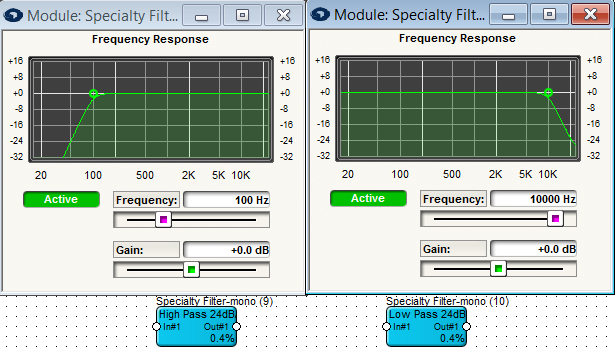
Controls:
-
Frequency. Determines the cut-off frequency of the filter. For low pass filters, all frequencies above this will be progressively attenuated. For high pass filters, all frequencies below this will be progressively attenuated. Technically, this frequency is the "3dB down point", i.e. the point where the filter response is 3dB lower than it is for unaffected signals.
-
Gain. Determines the amount of boost or cut applied to the signal as a whole. This setting is essentially a volume adjustment.
-
Bypass. Bypasses the module so that the input is sent unmodified to the output.
A graph is provided so you can view the frequency response of the filter. You can modify the filter parameters either by using the frequency and gain sliders or by dragging the green box on the graph.
Technical Note: The modules implement Butterworth filters which are generally preferred for audio because of it's flat frequency response in the pass band.
Note: If you need a steeper filter or programmable filter slope, consider using one of the crossover modules, or programmable High/Low Pass Filters. Steeper filters can also be obtained by cascading multiple filters, although using a crossover, or single programmable filter is generally preferred.