Allpass Filters
The allpass filter modules provide frequency-dependent delay without affecting a signal's amplitude. They affect the phase of a signal but not it's magnitude. They may be useful in cross-over applications to control the phase response at certain frequencies. All-pass filters are also sometimes used as "symmetry filters" to make a voice waveform more symmetric. This application is employed often in the radio industry for voice symmetry.
The first order allpass filter can provide up to 180 degrees of phase shift. The second order allpass filter can provide up to 360 degrees of phase shift and has a controllable Q, or (bandwidth) resonance.
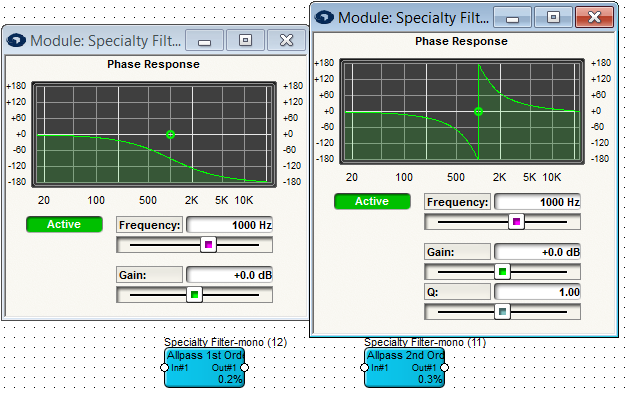
Controls
-
Frequency. Determines where the phase sift takes place. Technically, the indicated frequency is the point where the filter has reached half of its maximum phase shift. For example, for the first order filter with a 1kHz frequency, the signal is delayed by 90 degrees at 1kHz. Adjust using the slider or click in the text entry box to specify a numerical value.
-
Q (2nd order only). Determines how quickly the filter transitions from no phase shift to its maximum phase shift. This parameter is only available on a 2nd order all pass filter module. Adjust using the slider or click in the text entry box to specify a numerical value.
-
Gain. Determines the amount of overall gain applied to the signal. The gain is applied equally to all frequencies. This parameter is not reflected in the graph. Adjust using the slider, or click in the text entry box to specify a numerical value.
-
Bypass. When depressed, the filter is bypassed and the input audio is passed through unchanged to the output.
A graph is provided so you can view the phase response of the filter. In the graph, phase shifts larger than (-) 180 degrees are "wrapped" back to (+) 180 degrees. You can modify the crossover parameters either by using the sliders or by clicking and dragging on the graph. Drag the green box horizontally to adjust the frequency of the filter.