Crossovers
Crossovers are special filters that can be used to feed the different transducers of a loudspeaker system; woofers, tweeters and mid-range. The filters used in crossovers need to skillfully handle the point at which the two frequency bands overlap. At these frequencies where the bands overlap, two different transducers are both producing the signal. The filter's phase response at these frequencies is critical to ensure that phase cancellation which can produce comb filtering does not occur.
Symetrix offers 2-way, 3-way, and 4-way crossovers as well as a mono sub module. The 2-Way crossover has a high and a low output. The 3 way version adds a mid band output. The 4-way crossover has low, mid low, mid high, and high band outputs. All these crossovers have a single input signal. The mono sub module offers only a low output. It is essentially a low pass filter. It has two inputs which are summed to mono before the low pass filter is applied. If you are working with a mono signal, connect it only to input #1. When working with a stereo signal, you may want to apply some attenuation to compensate for the increased level obtained when summing the two inputs to mono.
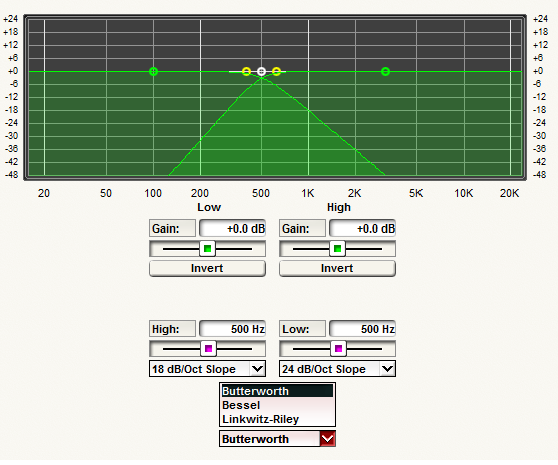
Controls:
- Gain. The gain adjustment provides a volume control for each frequency band.
- Invert. This button inverts the polarity of the output signal for each frequency band. It is equivalent to reversing the hot and cold wires of a balanced connection, or reversing the terminals on a loudspeaker. Use this setting for correcting reverse-wired speakers or for some crossover settings that require one band to be inverted vs. the other (e.g. 12dB and 36dB Butterworth).
- Frequency. Controls the frequency of each band. For Butterworth and Bessel type crossovers, this frequency is the 3dB down point. For L-R filters, it is the 6dB down point. Generally, the frequency settings for adjacent bands should be set to the same frequency as this yields the mathematically correct composite response. However, with some systems slight overlap or even underlap may be preferred due to room/speaker characteristics, or aesthetic reasons.
- Slope (6, 12, 18, 24, 30, 36, 42, 48). This setting controls the crossover slope in dB/octave for each band. With Bessel and Butterworth filters, "odd order" filters (6, 18, 30 and 42) are recommended. When you select Bessel or Butterworth and odd order setting is automatically chosen, but you may override this and use and even order if you desire. With L-R filters, only "even order" (12, 24, 36, 48) filters are available.
-
Butterworth, Bessel, and Linkwitz-Riley (filter type). Each of these filter types creates a slightly different response.
-
The standard Butterworth filter is a good compromise between a sharp but smooth cut-off and fairly good phase response. With Butterworth filters, "odd order" filters (6, 18, 30 and 42) are recommended. Only these filters have the phase responses which provide correct summing at the crossover point.
- The Bessel filter has better phase response in the pass-band, but does not roll-off as sharply and the summing at the crossover frequency is not perfect. The moderate improvements in pass-band response are usually not worth the disadvantages, so Bessel filters probably aren't of great value in most application.
- Linkwitz-Riley filters actually consist of two Butterworth filters in series. They have a significant advantage when used with speakers that have non coincident drivers (not coaxial), this is the woofer and tweeter are not physically in the same location. This is the case for most public address loudspeakers. For this type of loudspeaker, only L-R filters have zero "lobing error". This is defined as signal peaking caused by constructive phase interference that can occur off-axis to the loudspeakers. Linkwitz-Riley filters are very popular in the industry and are recommended for all non-coincident transducer applications. One disadvantage that the L-R filter has is that the combined power response of the (2) transducers has a slight dip in the crossover range. However, this is generally not audible, especially with higher order (more steep) filters where the crossover range is very small. With L-R filters, only "even order" filters are possible (12, 24, 36, 48). Of these, the 24- and 48-dB versions are preferred.
A graph is provided so you can view the frequency response of the various crossover bands. You can modify the crossover parameters either by using the sliders and buttons, or by clicking and dragging on the graph. Drag a green box vertically to adjust the gain of a band. Drag a yellow box horizontally to adjust the frequency of a band. Drag a white box horizontally to adjust the frequency of two adjacent bands at once.