xOut 12


Specifications
System
Sampling Rate: 48 kHz, ± 100 ppm
Frequency Response (A/D/A): 20 Hz – 20 kHz, ± 0.5 dB
Dynamic Range (A/D/A): > 114 dB, A-weighted
Channel Separation (A/D/A): > 108 dB @ 1 kHz, +24 dBu
THD+Noise: < -85 dB (unweighted); 1 kHz @ +22 dBu with 0 dB gain
Latency (A/D/A): 0.88 mS, inputs routed to outputs
Processors: 1 x Analog Devices SHARC 21489 @ 400 MHz SIMD
Raw processing capacity: 400 MIPS, 1.6 GFLOPS
Dante Cable: Standard CAT6, maximum device-to-device length = 100 meters
Analog Outputs
Number of Outputs: Twelve (12) balanced line level
Connectors: 3.81 mm terminal blocks
Nominal Output Level: +4 dBu with 20 dB of headroom
Maximum Output Level: +24 dBu (+22.8 dBu into a 2k Ohm minimum load)
Output Impedance: 300 Ohms balanced, 150 Ohms unbalanced
Dynamic Range: > 117 dB, A-weighted
THD + Noise: < -95 dB, unweighted; 1 kHz @ +22 dBu with 0 dB gain
Latency: 0.60 mS
Mechanical Data
Space Required
1U (WDH: 18.91 in x 9.5 in x 1.72 in / 48.02 cm x 24.13 cm x 4.37 cm). Depth does not include connector allowance.
Allow at least 3 inches additional clearance for rear panel connections. Additional depth may be required depending upon your specific wiring and connections.
Electrical
100-240 VAC, 50/60 Hz, 45 Watts maximum universal input. No line voltage switching required.
Ventilation
Maximum recommended ambient operating temperature is 30 C / 86 F. Ensure that the left and right equipment sides are unobstructed (5.08cm, 2 in minimum clearance). The ventilation should not be impeded by covering the ventilation openings with items such as news papers, tablecloths,curtains, etc. Ensure that the left and right equipment sides are unobstructed (5.08 cm, 2 in. minimum clearance). The ventilation should not be impeded by covering the ventilation openings with items such as newspapers, tablecloths, curtains, etc.
Certifications or Compliance
Safety: UL 60065, cUL 60065, IEC 60065
EMC: EN 55103-1, EN 55103-2, FCC Part 15
Environmental: RoHS
Shipping Weight
13 lbs. (5.9 kg)
A&E Specifications
The device shall provide twelve analog mic/line outputs that are adjustable from line to mic level with coarse gain, Levels, and mutes shall be controllable via software. Audio connections shall be accessed via rear panel 3.81 mm terminal block connectors.
Network audio expansion shall be provided by the Dante protocol with a capacity of 128 (64x64) channels. Primary and Secondary Dante network audio connections shall be provided for redundant network implementation. Connectors shall be gigabit RJ45 utilizing CAT6 cable.
A designer software application shall be provided that operates on a Windows computer, with network interface installed, running Windows® 7 or higher operating system. Computer connection for configuration shall be via the associated host/parent DSP's rear panel Ethernet connector. All PC Configuration connections must be done through host/parent DSP unit. All internal processing shall be digital (DSP). Audio intended for output by the xOut will need to be transmitted to the unit from the host/parent DSP through Dante Buses.
Audio conversion shall be 24-bit, 48 kHz and internal processing shall be 32-bit or 40-bit floating point, 48 kHz. The dynamic range shall not be lower than 115 dB, A-weighted with a maximum input level of +23 dBu and maximum output level of +24 dBu.
The device shall have an IEC power input socket for 120-240 VAC. The device shall meet UL/CSA and CE safety requirements and comply with CE and FCC Part 15 emissions limits. The device shall be RoHS compliant. The chassis shall be constructed of cold rolled steel and moulded plastic, and mount into a standard 19” 1U EIA rack. The device shall be aSymetrix Symetrix xOut 12.
Front Panel
| Item | Description | Comments |
|---|---|---|
| Signal Level LEDs | Twelve (12) bi-color LEDs | Illuminates green to indicate signal present > -48 dBu, amber between +0 dBu (-20 dBFS) and +23 dBu (-2 dBFS) and red to indicate clipping > +24 dBu (> 0 dBFS). All signal level LEDs will briefly flash amber on configuration load (on boot or when Composer pushes to hardware). |
| Power | Bi-color LED | Flashes green until the unit fully boots. If it remains flashing indefinitely, this may indicate a firmware or hardware problem. Solid green when operating on the main power input. The Power LED flashes green/amber to indicate a fan failure. |
| (Dante) Primary | Bi-color LED | Bi-color LED is off when nothing is connected, green when connected and all subscriptions are working, amber when some subscriptions working, and red when no subscriptions working. If a name conflict is detected, both the Primary and Secondary Dante LEDs will flash red. A name conflict means that 2 units were found on the network with the same name. |
| (Dante) Secondary | Bi-color LED | Bi-color LED is off when nothing is connected, green when connected and all subscriptions are working, amber when some subscriptions working, and red when no subscriptions working. If a name conflict is detected, both the Primary and Secondary Dante LEDs will flash red. A name conflict means that 2 units were found on the network with the same name. |
Rear Panel
| Item | Description | Comments |
|---|---|---|
| Power | IEC 3 prong jack | Accepts power from detachable IEC power cable (100-240 VAC, 50-60 Hz, 45 Watts max). Connect only to a grounded power outlet. |
| Dante (Primary) | RJ45 jack | 1000 Base-T Ethernet port provides 128 (64x64) channels of Dante network audio. |
| Dante (Secondary) | RJ45 jack | 1000 Base-T Ethernet port for redundant Dante network audio implementation in redundant mode, or for daisy chaining units without the need for extra switches and configuration in switched mode. The Dante Secondary port mode is switched in the Network I/O Manager. |
| Analog Line Outputs | Thirty-six (36) position 3.81 mm terminal block | Twelve (12) balanced analog line level audio outputs, individually software-selectable levels of -10 dBV or +4 dBu, fine gain and mute. |
Hardware Connections
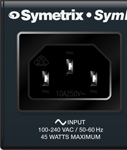 Power (Main): Connect the IEC connector end of the supplied AC cord to the receptacle on the rear of the Radius. Connect the AC connector end of the supplied AC cord to an AC power source that is of the correct voltage and frequency (100-240 VAC, 50-60 Hz). Use only the power cord and connector specified for the product and your operating locale.
 Dante (Primary): If using Dante network audio, connect the primary jack to directly to another Radius, 3rd party device, or Dante compatible switch using a standard straight-through CAT6 cable terminated with RJ45 connectors. For complete information on Dante network audio, network topologies, setup and configuration, refer to the Dante networking topics.
 Dante (Secondary): If using Dante network audio and daisy chaining Radius units locally, or utilizing a redundant Dante network configuration, connect the primary jack to directly to another Radius or Dante compatible switch using a standard straight-through CAT6 cable terminated with RJ45 connectors. For complete information on Dante network audio, network topologies, setup and configuration, refer to the Dante networking topics.
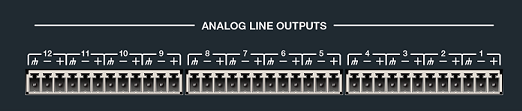 Analog Mic/Line Outputs: Using standard mic/line cables terminated on one end with terminal block connectors and appropriate connectors for your mic/line sources on the other end, connect the terminal block ends into the Analog Mic/Line Inputs on Radius and the opposite ends into your source devices' outputs. Refer to the Audio Wiring Reference for more information.
NOTE: Wiring the inputs to an unbalanced cable will typically result in an input level that is 6 dB lower than the input level achieved using a balanced cable. If wiring to an unbalanced source, you may need to adjust the input level. Refer to the xOut 12 Software topic.